
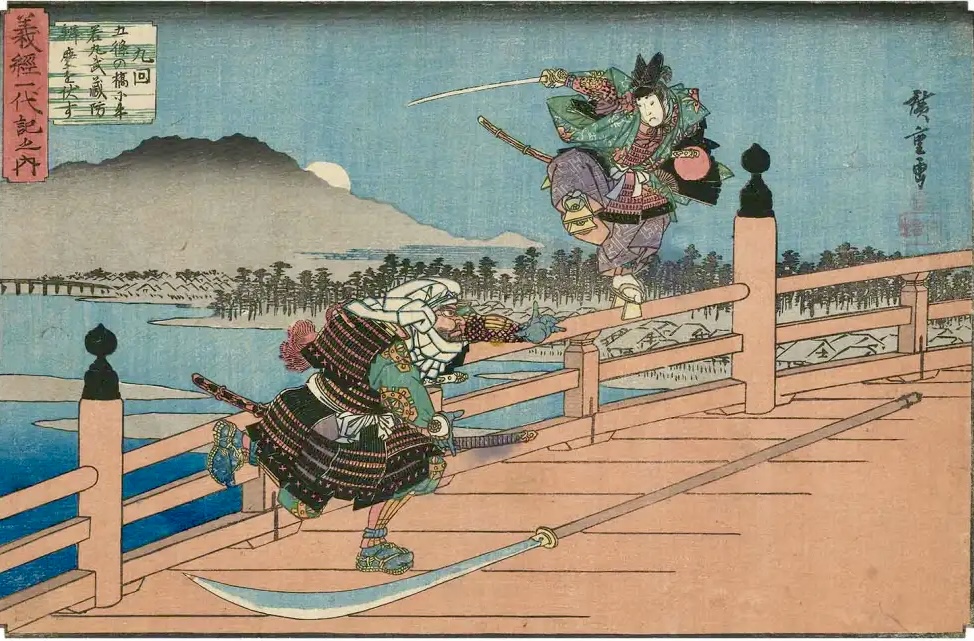
Pictured: Yoshitsune vs Benkei
By Ivan Melo
There is a difference between practising a martial art and being a martial artist.
Someone may train techniques, repeat forms, memorise sequences, and still fail to embrace the deeper problems that the practice places before us. A martial art does not deal only with movement, aesthetics, or tradition. It is born from a very concrete reality: violent confrontation between bodies.
This is not hypothetical. We are violent beings, both towards others and towards ourselves.
Today, we use the expression “martial art” almost automatically. It carries within it a mixture of ideas. “Martial” refers to Mars, the Roman god of war; budō, a Japanese term often translated as martial art, points instead to something like a “martial path.” They are not exactly the same thing, but the translation has become established. We therefore find ourselves in an intermediate territory: what is “art,” and what is “martial,” in what we practise?
For me, the martial artist is not defined only by their technical level. They are defined by the seriousness with which they face the dilemmas of practice. To be a martial artist is to take seriously the questions that arise when a technique involves imbalance, control, falling, impact, threat, pain, responsibility, and fear.
A martial artist cannot be satisfied merely with the execution of choreographies or beautiful forms. Kata, prearranged techniques, and structured exercises are important tools, but they must point towards something real. They must make us ask: does this work? How does it work? Against whom? In what context? What happens if I execute it badly? What happens if I use too much force, too little force? Too much intention, and not enough attention?
A badly executed technique is not merely an aesthetic mistake. It has consequences. It can injure a partner, create illusions about one’s own ability, and feed vanity, rigidity, fear, or aggression. For this reason, practice must be more than repetition. It must be investigation.
To be a martial artist is to study one’s own body and the body of the other, distance, timing, balance, intention, and confrontation. It is to understand that the training partner is neither an obstacle nor an enemy, but also not someone to be treated as a mere accessory to our performance. A good partner is a catalyst: they are the concrete measure of our practice. It is with them that we discover whether what we do has presence, effectiveness, care, and truth.
After this first question – the technical and combative viability of a technique when two people are engaged in a situation of conflict – a second dimension immediately, arises: the emotional, psychological, and spiritual responses that appear in the face of the possibility of violence.
Here, once again, we are speaking of fear.
Fear is perhaps the most fundamental emotion in this territory. From it may arise anger, the need for control, rigidity, aggression, hesitation, wounded vanity, the greed for victory, or the refusal to accept one’s own vulnerability. Fear reveals many things. It reveals our ignorance, our illusions about ourselves, our defence strategies, and that which we have not yet managed to reconcile within ourselves. It verifies and reifies our attachment to the self.
For this reason, the martial artist must take the investigation of fear seriously.
It is not enough to speak of courage, self-control, or serenity as abstract ideas. Practice must create real conditions, even if gradual and safe, for the practitioner to encounter fear in the body. They must place themselves in situations where something of this tension appears: the pressure of the other, the loss of balance, the proximity of attack, uncertainty, the momentary inability to control everything.
It is in this encounter that practice begins to reveal its depth.
As an anecdote, one of our students once told us that, before finding our dojo, he was visiting other dojos and trying other martial arts. When he visited a local school for the first time, he encountered an environment charged with machismo and testosterone. After the class, while speaking with the instructor, the instructor reaffirmed the martial viability of his style and of his school. The conversation then took an unexpected turn, and the same instructor revealed a health condition he was dealing with – with a fairly routine impending medical procedure – and he went from fearless fighter to a frightened child in an instant.
Our student realised that, in that dojo, something was missing.
Fear is a common, necessary, and intelligent human emotion. The goal is not to eliminate fear, as if that were possible or even desirable. The problem is not feeling fear. The problem is being governed by it without noticing. The martial path requires us to learn to recognise fear, listen to it, move through it, and, little by little, reconcile ourselves with it.
In this sense, martial art is not only about learning how to deal with external violence. It is also about perceiving the subtle forms of violence we carry within ourselves: haste, the desire to win, the desire to control, the fear of losing, the need to appear competent. Practice reveals these things. And perhaps it is precisely there that the path begins.
Someone who does not take this seriously may, without doubt, practise a martial art. They may practise it as physical exercise, as a social activity, as a form of mobility, health, discipline, friendship, or belonging to a community. There is nothing wrong with that. These aspects are valuable and legitimate.
But perhaps this is still not enough to make someone a martial artist.
The martial artist is someone who takes very seriously two inseparable dimensions: the technical and tactical function of what they study, and the internal study of the emotions that arise in human confrontation. They study violence between human beings not in order to glorify it, but in order to understand it, refine it, move through it, and transform it into a path.
Speaking of technique, the Japanese word jutsu (術 ) is often translated as technique, method, or art. But technique, here, does not need to be understood in a cold, mechanical, or purely utilitarian way. Technique can also be a way of navigating the world: a way of responding to challenges with greater skill, presence, beauty, and ease.
The more we learn about the historical context of Japanese martial traditions and their more distant past, the more we realise that the relationship between 術, jutsu, and 道, dō, was never simply an opposition between technique and path. This distinction took on modern contours from the Meiji period onwards and became more firmly established in the early twentieth century, but it reveals something deeper: the understanding of technique did not need to be separated from the path. To walk a path requires a proper understanding of the terrain, the conditions, and the tools necessary to traverse it. It is an idea that is deeply practical and philosophical at the same time.
The modern distinction between jutsu and dō perhaps reveals a tension created by Japanese modernisation itself. As Meiji Japan industrialised and sought to stand alongside the West, “technique” could come to be understood in a narrower way: as method, efficiency, application, and the production of results. In this context, calling a practice dō was also a way of resisting the reduction of technique to a mechanism. It was to affirm that technique, when truly understood, is not merely an instrument, but a path: a form of education of the body, the mind, perception, and character.
To practise a martial art is to learn techniques. To be a martial artist is to allow those techniques to transform the way we relate to conflict, to the body, to the other, and to ourselves. The difference lies in the depth of the question we bring to the tatami- and from there, to the rest of our lives.
In the end, each person will choose the path they wish to walk. These days, I prefer to refer to my own practice as the path of the warrior, an expression that has a more precise relationship with budō than “martial art.” Even so, words are only words, pointing towards something that cannot be named.
Recently, I came across a dōka, a poem of the path attributed to Morihei Ueshiba, which points to the same direction:
武とはいえ声もすがたも影もなし
神に聞かれて答うすべなし
Though we speak of the martial,
there is no voice, no form, no shadow.
If the kami were to ask,
there would be no answer to give.
Contact
St Matthew's Church Hall, North Common Road, Ealing W5 2QA (no mail by post)
Hours
Mondays
4:45pm-5:45pm & 5:50pm-6:50pm: Children's programme
7:00pm-7:30pm: Zazen
7:30pm-8:45pm: Aikido (Adults)
Tuesdays:
7pm-8pm: Aikido (Adults & 16+)
8pm-9pm: Weapons
Thursdays
7pm-8pm: Aikido (Adults & 16+)
8pm-9pm: Aikido (Adults)