
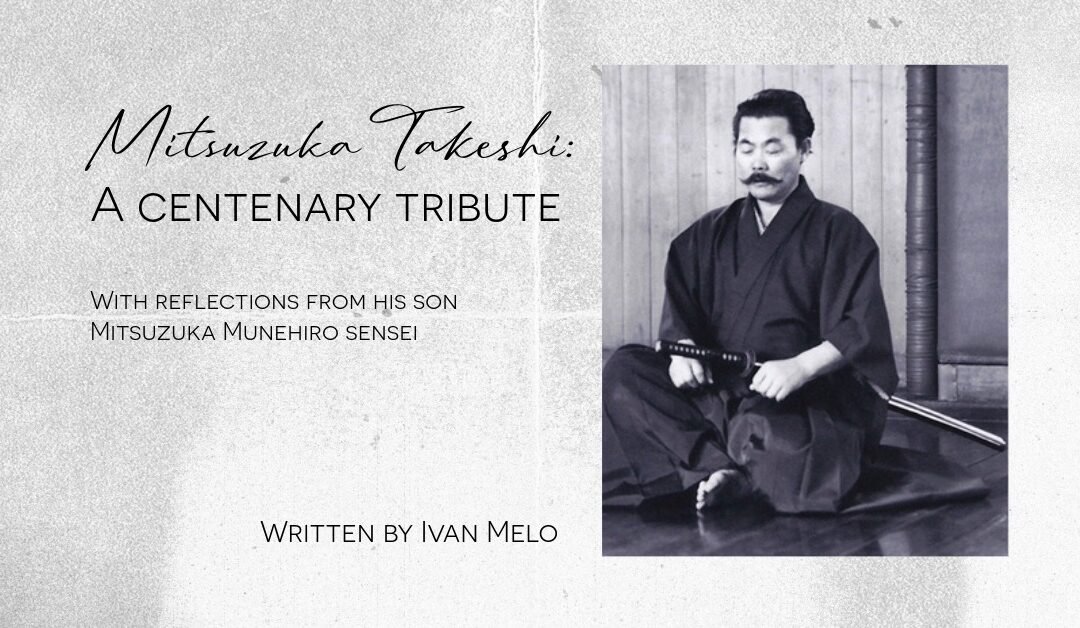
Remembering a Direct Student of Nakayama Hakudō
Editor’s note: This article has been published to mark the centenary of Mitsuzuka Takeshi’s birth (1926–2008). It is based on a written interview graciously provided by his son, Mitsuzuka Munehiro Sensei, in 2026. Responses have been lightly edited for clarity and arranged thematically, while preserving their original meaning.
2026 marks one hundred years since the birth of Mitsuzuka Takeshi (三塚猛-09/15/1926), one of the most influential yet least documented figures in the modern history of Musō Shinden Ryū Iaidō. Although countless practitioners have unknowingly studied his movements through the photographs published in Donn F. Draeger and Gordon Warner’s Japanese Swordsmanship, relatively little has been written about the man himself.
A direct student of Nakayama Hakudō, founder of San Shin Kai, Mitsuzuka Takeshi occupied a unique position during a period when Japanese budō was beginning to extend beyond its national boundaries. One of the earliest teachers to welcome non-Japanese students into a traditional Musō Shinden Ryū dojo, he introduced generations of practitioners in Japan, Europe, and North America to an approach to Iaidō that remained firmly rooted in the traditions he had inherited. Yet martial traditions are rarely preserved through books alone. Techniques may be recorded, but the atmosphere of a dojo, the character of a teacher, and the values that shape a lineage often survive only in the memories of those who experienced them firsthand.
To commemorate the centenary of his birth, Gyodokan invited his son, Munehiro Mitsuzuka Sensei (三塚宗広), to reflect on his father’s life, his years under Nakayama Hakudō, the founding of San Shin Kai, and the continuing responsibility of transmitting a living tradition.
What follows is not intended as a complete biography. Rather, it is a collection of memories – small but illuminating glimpses into a generation of budō that is steadily passing from living memory.
A House Built Around Budō
One of the first stories Munehiro Sensei shared about his father was not about swordsmanship at all. It was about family.
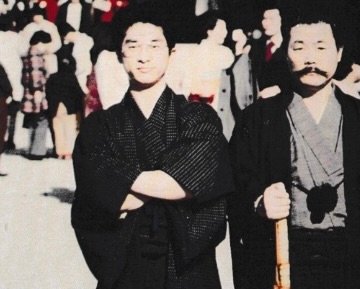
Picture: Mitsuzuka Munehiro with his father. (sanshinkai.org)
Munehiro’s own birth, he explained, was unexpectedly difficult. The delivery was so severe that doctors feared neither mother nor child might survive. Faced with that uncertainty, Mitsuzuka Takeshi arrived at the hospital carrying a sword and, according to family memory, confronted the medical staff with uncompromising determination to ensure that every possible effort was made to save them both. The anecdote conveys something essential about his character: an unwavering resolve when those he cared for were at stake.
Munehiro sensei also recalled that his father began pursuing martial arts in earnest after learning that he would become the father of a son. In Japan at the time, the birth of a male heir carried particular significance, especially in a family where the responsibility of carrying on the family trade and legacy traditionally fell to the first-born son. What began, perhaps, as a sense of responsibility toward the future of his family would eventually become a lifelong dedication to budō.
Over the years, Takeshi immersed himself in a wide range of disciplines, including Kendō, Jūdō, Jōdō, Karate, and, of course, Iaidō. For many practitioners of his generation, such breadth was entirely natural. Budō was not necessarily understood as a collection of isolated arts, but as complementary expressions of a shared martial culture.
But the story of the Mitsuzuka household cannot be told through Takeshi alone.
Munehiro sensei remembers his mother, Hiroko Mitsuzuka (広子三塚), with great affection, respect, and admiration. Born on November 13, 1936, Hiroko was only twenty years old when Munehiro was born.
The circumstances of her meeting with Takeshi were themselves closely connected to his work as a police officer. At the time, one of the duties of Tokyo Metropolitan Police officers was to visit households within their patrol areas to check family registers. Hiroko’s family home happened to fall within Takeshi’s patrol area.
She was the youngest of six children – three daughters and three sons – and was working as a bus conductor, a profession whose duties at the time included selling tickets to passengers and announcing stops. Her sisters worked in the same occupation. Hiroko also practised shodō while working for Mitsukoshi Department Store.
She was not merely a supporter of budō from the sidelines, however. Hiroko herself practised jōdō and attained 3rd dan. She supported everything her husband did, and Munehiro remembers the family as a very typical “old-fashioned” Japanese household: the man led, while the woman followed.
There is an important nuance in this recollection. Hiroko’s role was not simply that of a wife accommodating her husband’s interests. She was herself a budō practitioner, and her support for Takeshi’s activities came from within the same martial world that shaped his life. The distinction matters because it helps us understand the environment in which their son was raised: budō was not something that belonged exclusively to his father.
The home into which Munehiro was born soon became inseparable from the dojo itself. After training, students regularly gathered at the Mitsuzuka family home, first in a house and later in a small apartment where conversation continued long into the evening.
“The floor would almost drop to the ground,” Munehiro sensei recollecting these informal training sessions.
For a child growing up in that environment, martial arts were not something one attended a few evenings each week. They formed the rhythm of everyday life. The dojo extended into the home, and the home, in turn, became part of the dojo.
Munehiro began practising kendō at the age of ten before naturally progressing to Iaidō and Shindō Musō-ryū Jōdō. The transition was neither formal nor imposed. It simply reflected the world around him.
In the Mitsuzuka household, then, budō was not simply something that Takeshi taught. It was the culture of the family itself.
The Quiet Weight of War
Although Mitsuzuka Takeshi belonged to the generation shaped by the Second World War, he spoke little about those experiences. When memories did surface, they appeared only as fragments.
Munehiro sensei believes that his father suffered from what today would likely be recognised as post-traumatic stress. He occasionally mentioned being pursued by American P-38 Lightning fighters, memorising torpedo diagrams during his naval service, and enduring harsh treatment during military training. These recollections were never offered as heroic tales. They emerged quietly and without embellishment before retreating once more into silence.
If the war remained largely unspoken, the discipline it fostered left a lasting impression.
Munehiro sensei remembers the police dojo of his youth as a place of remarkable seriousness. Expectations were clear, etiquette uncompromising, and practice conducted with an intensity that reflected the generation teaching there. Later, when he joined kendō clubs in junior and senior high school, he found the atmosphere markedly different.
“It was not as it should be,” he reflected simply.
Rather than compromise the standards he had come to expect, he chose to distance himself from those clubs altogether.
The contrast points to something larger than differences in etiquette. Mitsuzuka Takeshi belonged to a generation whose understanding of budō had been shaped by direct experience of hardship, institutional discipline, and teachers whose own formative years reached back into pre-war Japan. Those circumstances cannot be recreated, but traces of them remain embedded within the traditions passed down to subsequent generations.
Remembering Through Practice
When asked what he believes his father would most want preserved, Munehiro sensei rarely pointed to a specific kata or technical detail. Instead, his recollections consistently returned to something less tangible: the manner in which practice itself should be approached.
Throughout our conversation, he spoke less about achievement than about continuity. Less about mastery than about perseverance.
Those themes would reappear repeatedly as we turned to Mitsuzuka Takeshi’s years under Nakayama Hakudō, the founding of San Shin Kai, and the challenges of preserving a traditional lineage in the twenty-first century.
If this centenary encourages practitioners to look beyond lineage charts and photographs – to remember not only how Mitsuzuka Takeshi moved, but why he practised – then it will have served its purpose.
The story begins, appropriately enough, with the teacher who shaped him.
The Last Years of Nakayama Hakudō
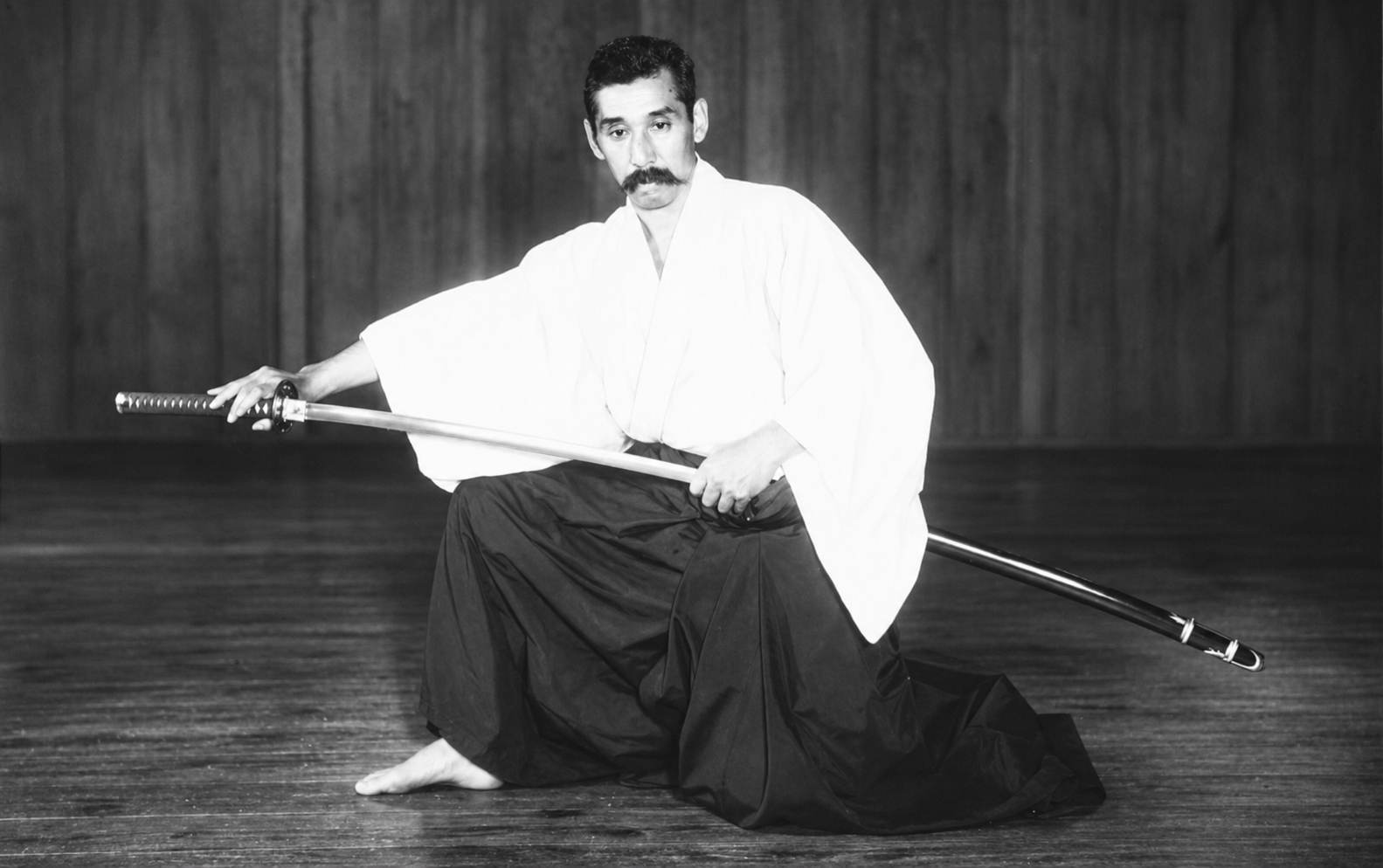
Picture: Nakayama Hakudo
Every martial tradition has moments that later generations wish had been better documented.
Photographs capture posture. Films preserve movement. Certificates establish lineage. Yet none of these can fully convey what it was like to stand before a teacher, to receive a correction at precisely the right moment, or to understand why a seemingly insignificant detail mattered.
For practitioners of Musō Shinden Ryū, Nakayama Hakudō (1872–1958) remains one of the defining figures of modern Japanese swordsmanship. His influence extended beyond Iaidō into Kendō and the classical sword traditions at a time when Japan itself was negotiating the place of budō in the modern world. Yet for many of those who knew him personally, the years available to study under him were remarkably few.
Mitsuzuka Takeshi began studying Iaidō under Hakudō in 1955. Only three years later, the old master passed away. By any measure, it was a brief apprenticeship. Yet, as Munehiro sensei’s recollections suggest, those few years left an impression that endured throughout his father’s life.
Rather than preserving dramatic stories about his teacher, Mitsuzuka Takeshi left behind something far more modest: handwritten notes.
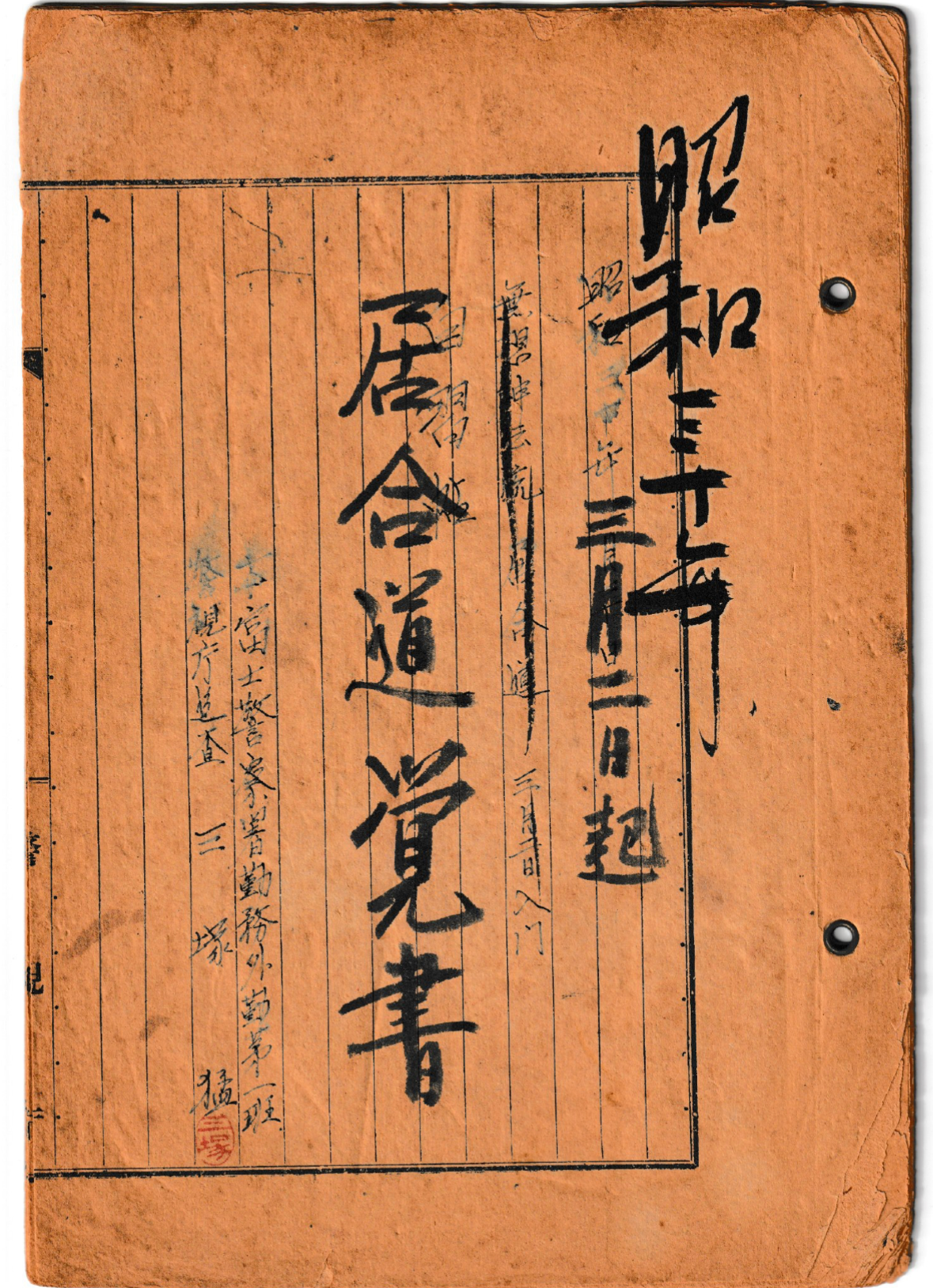
Front page of Mitsuzuka sensei’s training diary- provided by his son.
“Day three… it’s getting interesting.”
The note is striking precisely because of its ordinariness. It reveals neither secret techniques nor profound philosophical insights. Instead, it captures the quiet enthusiasm of a student discovering what would become a lifetime’s work. For Munehiro sensei, it offers a rare glimpse into his father’s state of mind during those formative years.
“Apparently,” he reflected, “he was enjoying the class.”
There is something refreshingly human about this small fragment of paper. We often imagine the transmission of classical martial arts as a succession of profound moments and hidden teachings. Instead, the first surviving trace of Mitsuzuka’s apprenticeship records something much simpler: the joy of learning.
Learning to See
Another story, preserved through oral tradition within the San Shin Kai lineage, offers a glimpse into Nakayama Hakudō’s style of instruction.
It is said that during Mitsuzuka’s early training, Hakudō required him to practise Shōhatō, the opening kata of the Ōmori-ryū series.
The lesson unfolded with remarkable simplicity. Hakudō would sit nearby, quietly reading a newspaper. Mitsuzuka would perform the kata. Without even looking up, the old master would simply say: “No.”
The kata would begin again. Day after day. Week after week, for approximately six months before allowing him to move on to the next form.
Whether every detail of the story can be historically verified is almost beside the point. What matters is what it conveys about the kind of teacher Hakudō was—and what Munehiro sensei’s own recollections consistently reinforce about his father: for Takeshi, Iaidō was never about accumulating techniques. It was about refining the practitioner.
Munehiro sensei recently shared a page of his father’s own writing concerning the mindset expected of beginners. The final two lines read:
“If someone is doing it one time, you do one hundred of it.
If someone is doing it ten times, you do a thousand of it.”
The words offer a striking glimpse into the mindset with which Takeshi approached his own training. The lesson of repetition that emerges from the story of Hakudō’s Shōhatō instruction was not something that ended with his teacher. It became part of Takeshi’s own understanding of practice.
“Just imagine being the son of a father with this mindset,” Munehiro sensei said. Then, after a moment, he added simply: “It’s not easy.”
Perhaps that is what makes the story of Shōhatō so revealing. Behind the seemingly endless repetition was not merely a demand for technical perfection, but a conception of budō in which perseverance itself became part of the training. The student was not simply learning a kata. He was learning how to remain with something long after the desire to move on had disappeared.
After Hakudō
Hakudō’s passing did not mark the end of Mitsuzuka Takeshi’s education.
Like many students of that generation, he continued training with senior practitioners who had themselves studied under the old master. Among those Munehiro sensei remembers most clearly was Danzaki Tomoaki of Ken Shū Kan (研修館), a former sumō wrestler whose dojo still contained a dohyo:
“When I visited his dojo,” Munehiro sensei recalled, “the sumō ring was still there and the fundoshi string pants”!
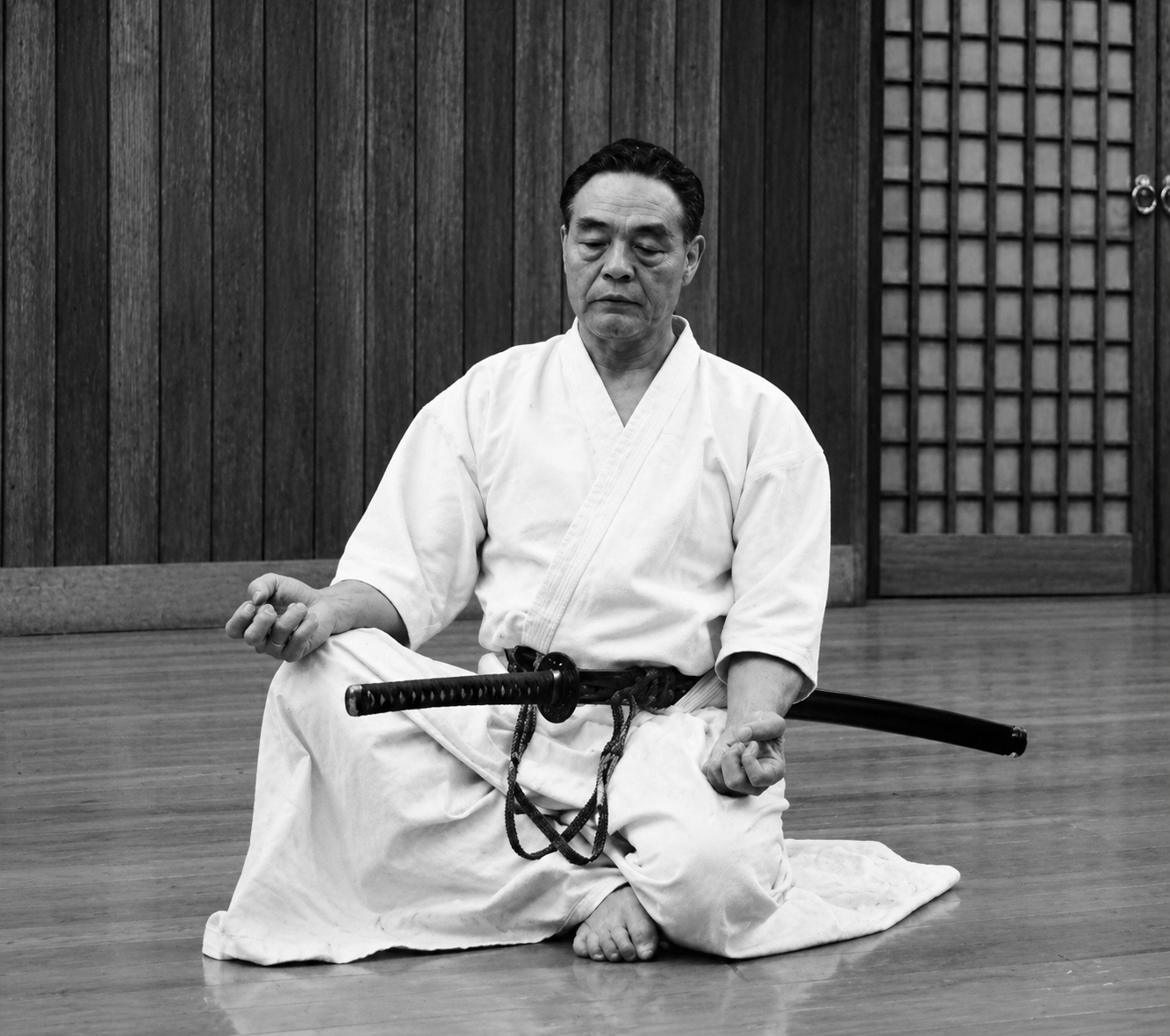
Picture: Tomoaki Danzaki sensei (Source- Iaido: Its Logic and Essence)
The memory survives not as a technical lesson but as a vivid image. It is an evocative detail. Today we often think of Kendō, Iaidō, Jōdō, Jūdō, and Sumō as clearly separated disciplines. Mid-century Japan was rather less compartmentalised. Teachers moved comfortably between martial traditions, and many regarded them as different expressions of a shared culture rather than isolated systems.
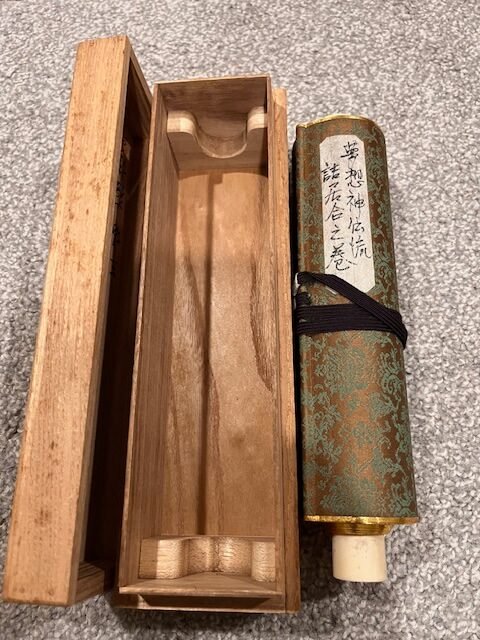
Among the materials preserved by the Mitsuzuka family is an Okuden scroll of Musō Shinden Ryū that Munehiro sensei explains was presented to his father by the senior disciple Ōmura Shinji after Nakayama Hakudō’s death. The document illustrates an important but often overlooked aspect of koryū transmission: although a founder or headmaster may become the defining figure of a lineage, the practical work of educating the next generation frequently passes through trusted senior students.
Mitsuzuka Takeshi himself embodied this breadth of practice throughout his life.
Preserving Movement Rather Than Interpretation
When discussion turns to technical differences between lineages, practitioners often expect elaborate explanations of body mechanics or hidden principles.
Munehiro sensei offers something considerably more restrained.
Asked about the relationship between Musō Shinden Ryū and the Shindō Munen Ryū forms that became part of the San Shin Kai curriculum, he answered with notable humility.
“I don’t know much about the difference between Shindō Munen Ryū and Musō Shinden Ryū myself. I have simply continued the technique as it was taught and keep practising.”
For readers accustomed to technical debate, the response may seem unexpected. Yet it reveals something fundamental about traditional transmission. Munehiro sensei does not see himself primarily as an interpreter of the tradition but as its custodian.
Only then does he point to one technical characteristic that distinguishes the San Shin Kai approach. The kissaki during furikaburi is raised noticeably higher before the downward cut than in many contemporary Musō Shinden Ryū groups.
“We are keeping what Master Nakayama’s photograph shows,” he explained.
Other branches, he noted, lower the tip of the blade considerably more before cutting. To an outside observer, such a difference might appear insignificant.
Within traditional Japanese arts, however, fidelity often resides precisely in these seemingly minor details. A posture, a rhythm, or the angle of a blade may preserve assumptions about distance, intention, and movement that words alone cannot adequately explain.
Significantly, Munehiro sensei never suggests that his father’s way is the only correct one. Nor does he speculate about why other branches evolved differently. He simply points back to Nakayama Hakudō.
That restraint is, perhaps, itself part of the transmission.
An Unfinished Story
One episode from Mitsuzuka Takeshi’s career remains only partially illuminated.
When Donn F. Draeger and Gordon Warner published “Japanese Swordsmanship”, the photographs illustrating the newly established Zen Nihon Kendō Renmei Seitei-gata featured Mitsuzuka Takeshi as the model. For many Western practitioners, these images became their first visual encounter with modern Iaidō and have been reproduced continuously ever since.
Asked whether his father hoped the book would help introduce Seitei to the wider world, Munehiro sensei simply replied that he did not know. He did, however, recall one detail that had remained with him.
According to Munehiro sensei, Draeger had promised payment for his father’s participation but never fulfilled that promise. It was not something Mitsuzuka Takeshi discussed publicly, yet it remained among the quiet memories preserved within the family.
The anecdote serves as a gentle reminder that the international spread of budō depended not only upon celebrated authors and organisations, but also upon teachers whose contributions often remained largely invisible. Behind every famous publication stand practitioners whose names are less widely recognised, yet whose movements shaped how generations would come to understand the art.
The Birth of San Shin Kai
If Nakayama Hakudō represented one generation of Japanese swordsmanship, Mitsuzuka Takeshi belonged to the next: a generation confronted with a new challenge. The question was no longer simply how to preserve a classical tradition within Japan. It was how to preserve it as the world itself began arriving at the dojo door.
By the late 1960s, Mitsuzuka Takeshi founded San Shin Kai to provide a place where traditional Musō Shinden Ryū could be practised with seriousness and continuity. According to Munehiro sensei, there were many enthusiastic Japanese practitioners who wanted to study authentic Iaidō under his father. At the same time, many established dojos remained hesitant to accept non-Japanese students, a reflection of the cultural and linguistic barriers that still existed during those years.
Munehiro sensei suspects that his father also had another reason for looking beyond those boundaries. From the age of ten he had encouraged his son to study English alongside his regular schooling.
Looking back, Munehiro believes his father may already have been thinking about the future – one in which Japanese budō would increasingly be practised by people far beyond Japan’s shores. In retrospect, that instinct proved remarkably prescient.
A Dojo Without Borders
The relationship between San Shin Kai and the Aikikai would become one of the most significant chapters in the school’s history.
Munehiro sensei recalls that Kazuo Chiba sensei approached Mitsuzuka Takeshi with a request that would quietly reshape the future of Iaido, especially in the West. Members of the Aikikai wished to study Iaidō, and Chiba sensei personally requested Mitsuzuka sensei to accept non-Japanese students into its training – and he agreed.
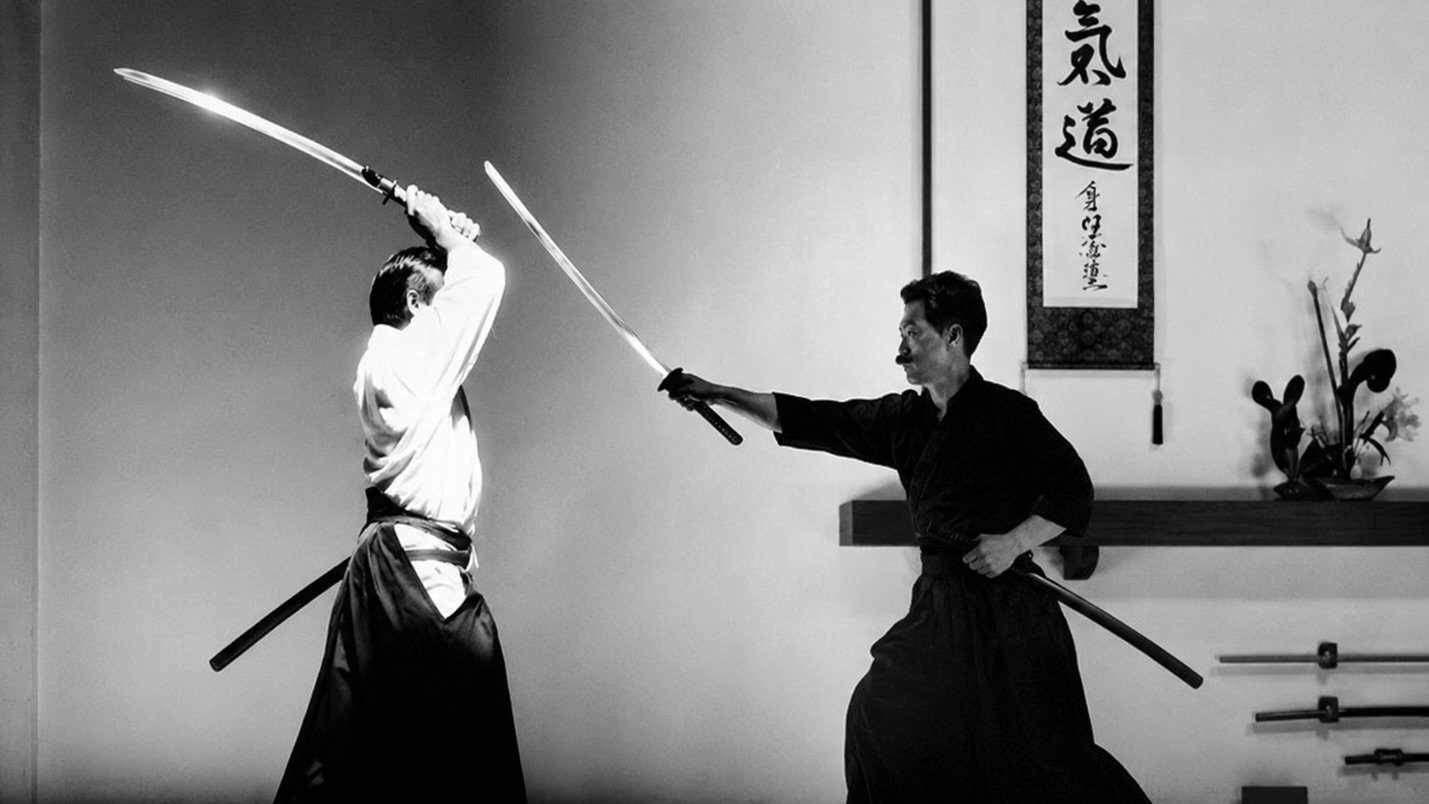
Photograph: Mitsuzuka Takeshi sensei with Chiba Kazuo sensei. (From aikidodidierboyet.com)
For modern readers, this may seem an unremarkable development. During the 1960s and 1970s, however, it represented a considerable step. Few traditional dojos had experience teaching foreign practitioners, and language, etiquette, and cultural expectations often presented genuine obstacles.
The first group consisted of only five students. What happened next is perhaps one of the most remarkable details to emerge from Munehiro sensei’s recollections.
Although still in his mid-teens, he became responsible for teaching those students himself.
“I taught all of them at Yotsuya Police Station,” he recalled, “when I was fifteen to eighteen years old.”
At the time, he already held third and later fourth dan in ZNKR Iaidō. Chiba sensei personally guaranteed the students who entered the dojo, and many more would follow through this connection.
Looking back, it is difficult to overstate the significance of those years. Many Western practitioners trace their understanding of Musō Shinden Ryū, directly or indirectly, to teachers who passed through San Shin Kai during this period.
Later on, his father would travel to Europe and US to teach Iaido to Kazuo Chiba, Tamura Nobuyoshi, Mitsunari Kanai and their students.
More Than Examinations
When asked about contemporary Iaidō, Munehiro sensei offered one of the most candid reflections of the entire interview.
“I don’t know what the Iaido or Kendo Federations think of Master Nakayama these days,” he observed. Then he added, “Nowadays, most Iaidō students only practise Seitei to pass dan tests, which is killing koryū.”
The statement is not a criticism of Seitei-gata itself. Mitsuzuka Takeshi had, after all, contributed to its early dissemination through the photographs published in Japanese Swordsmanship. Rather, it expresses a concern about purpose.
Seitei was created as a standardised curriculum through which practitioners from different traditions could share a common language. It was never intended to replace the classical schools from which its techniques were drawn. When examination becomes the principal objective of practice, there is a danger that efficiency begins to overshadow inquiry, and that kata become exercises in performance rather than vehicles for transmission.
This concern echoes a broader tension found throughout the history of Japanese martial arts. Every generation inherits traditions shaped by different circumstances. The challenge lies not in resisting change altogether, but in discerning which changes enrich a tradition, and which quietly erode the qualities that made it worth preserving in the first place.
For Munehiro sensei, the answer lies not in argument, but in continued practice.
The Responsibility to Continue
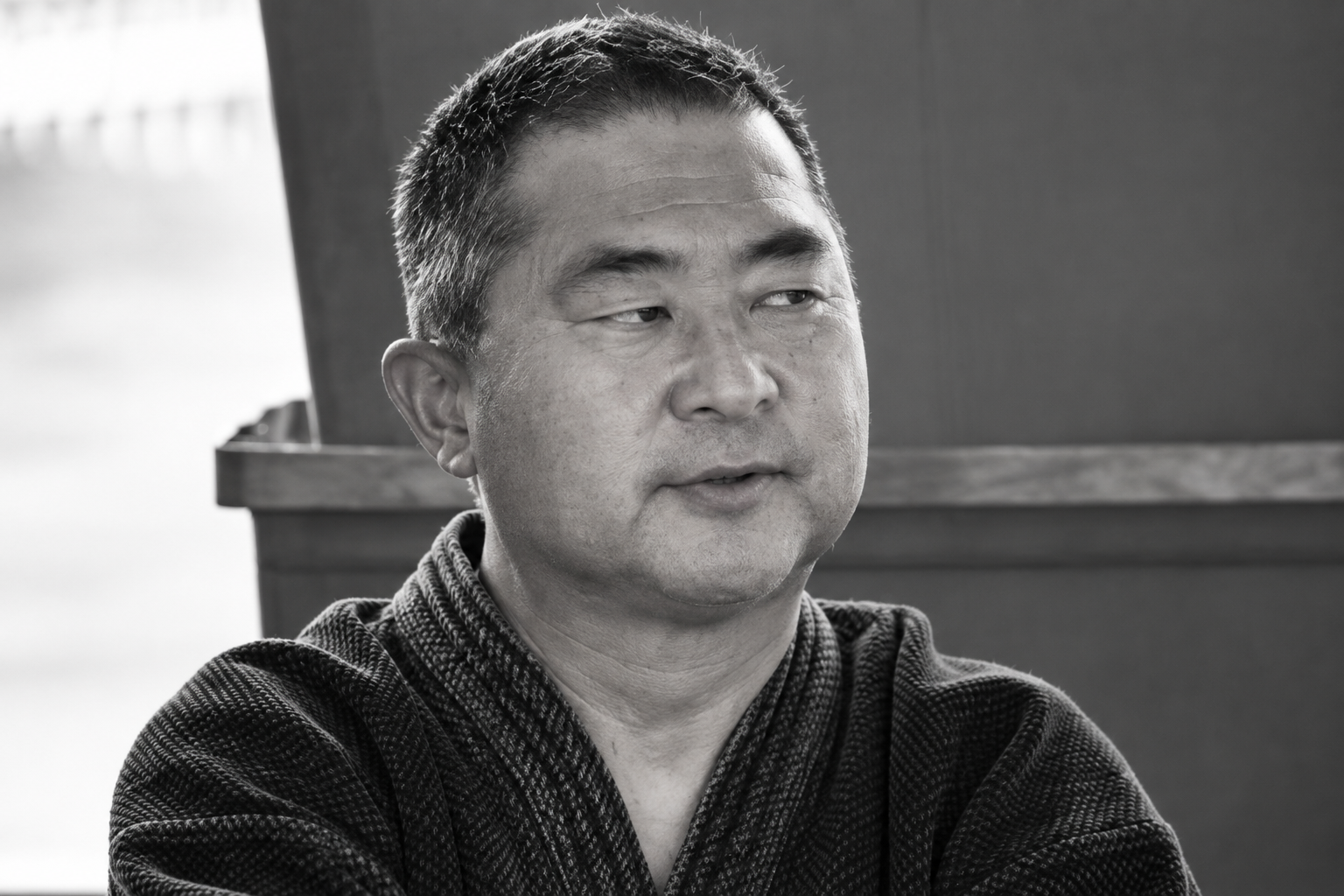
Unlike many successors to prominent teachers, Munehiro sensei (pictured above) rarely speaks of preserving his father’s legacy in grand terms. Instead, he frames the responsibility in deeply personal language.
Reflecting on his life in North America, he explained that he often asks himself what he can give back to the country that has welcomed him.
“If someone asks where you are from,” he reflected, “and what you can do, how would you respond?”
His own answer is straightforward.
“I am from Japan, and I practise and teach Iaidō.”
There is no suggestion that this makes him exceptional. Rather, teaching becomes an act of gratitude.
The image is strikingly consistent with everything that has emerged throughout this conversation. Tradition is not something one possesses. It is something entrusted to one’s care.
Even discussions of archival preservation reveal the same outlook. Munehiro sensei notes that relatively little visual material survives from his father’s lifetime. There are photographs, and a DVD recorded during one of Mitsuzuka Takeshi’s visits to Boston, but nothing resembling the extensive digital documentation available today. Instead, he places his confidence in the people who continue to practise, teach, and pass the tradition to others.
Perhaps the most moving observation concerns the future of koryū itself. Many of his most dedicated students today are not Japanese. With quiet optimism, he suggests that one day these practitioners may find themselves teaching traditional Iaidō back to Japanese students.
The history of transmission, it seems, continues to unfold in unexpected ways.
A Century of Transmission
One hundred years after Mitsuzuka Takeshi’s birth, the questions that shaped his life remain remarkably familiar.
How does a martial tradition survive?
How does one preserve a teacher’s work without merely copying it?
How much may change before a tradition ceases to be itself?
Munehiro sensei never attempted to answer these questions as abstract philosophy. Instead, he answered them in the way he had learned from his father: through stories, through examples, and through a lifetime of continued practice.
Perhaps that is why so many of his recollections return not to extraordinary techniques, but to ordinary moments – a crowded apartment after training, a handwritten note from a young student of Nakayama Hakudō, the discipline of a police dojo, or a photograph preserving the height of a sword before the cut.
As our conversation drew to a close, Munehiro sensei offered one final reflection that seemed to capture both his own approach and, perhaps, something of his father’s as well.
“Iaidō does not require physical strength. Even if you are eighty years old, you can continue practising at your own pace. Cutting rolled straw is not Iaidō, just as breaking boards is not karate. It requires lifelong dedication. Don’t give up completely. You can always come back when you’re ready.”
There could be no more fitting tribute in the centenary year of Mitsuzuka Takeshi.
For if his legacy can be found anywhere today, it is not only in the photographs that introduced generations of practitioners to modern Iaidō, nor solely in the continued existence of San Shin Kai. It lives most clearly in the quiet continuation of a way of practising – one that values patience over haste, sincerity over recognition, and faithful transmission over personal acclaim.
One hundred years after his birth, that legacy continues to be carried, one kata at a time.