
Written by Ivan Melo
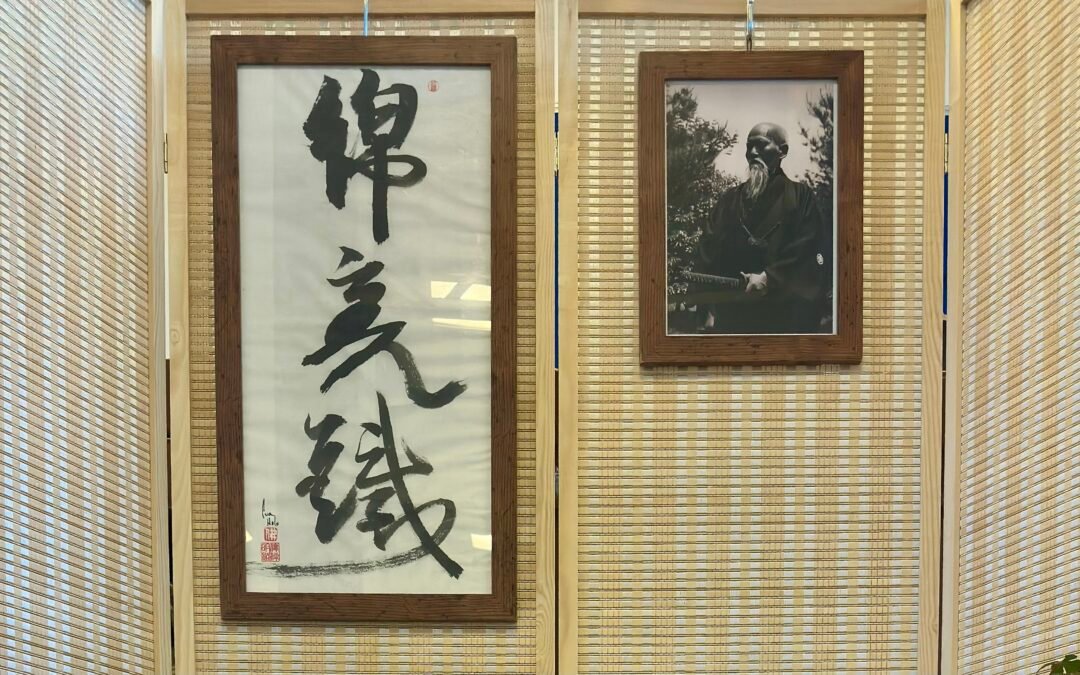
For a while, I had been wanting to change the calligraphy piece in the dojo’s kamiza. The first one, Kenshō (見性), stayed on display for more than two years.
I cannot say exactly what was driving me to change the piece, as the invitation to discover our true nature through the path of Aikido is an ever-present reality. If anything, it is something we can never really leave behind.
Perhaps, as the group of deshi who stayed with us needed a new aim for their practice, I was also looking for a new “finger pointing at the moon”.
The new calligraphy is the Chinese phrase 綿裹鐵 (Mián guǒ tiě), which can be translated as “iron wrapped in cotton.” The phrase has its origins not in martial arts, but in Chinese calligraphy.
The Northern Song literatus and calligrapher Su Shi (蘇軾, 1037–1101) famously described his own handwriting with the words:
我書如綿裡裹鐵
“My writing is like iron wrapped in cotton.”
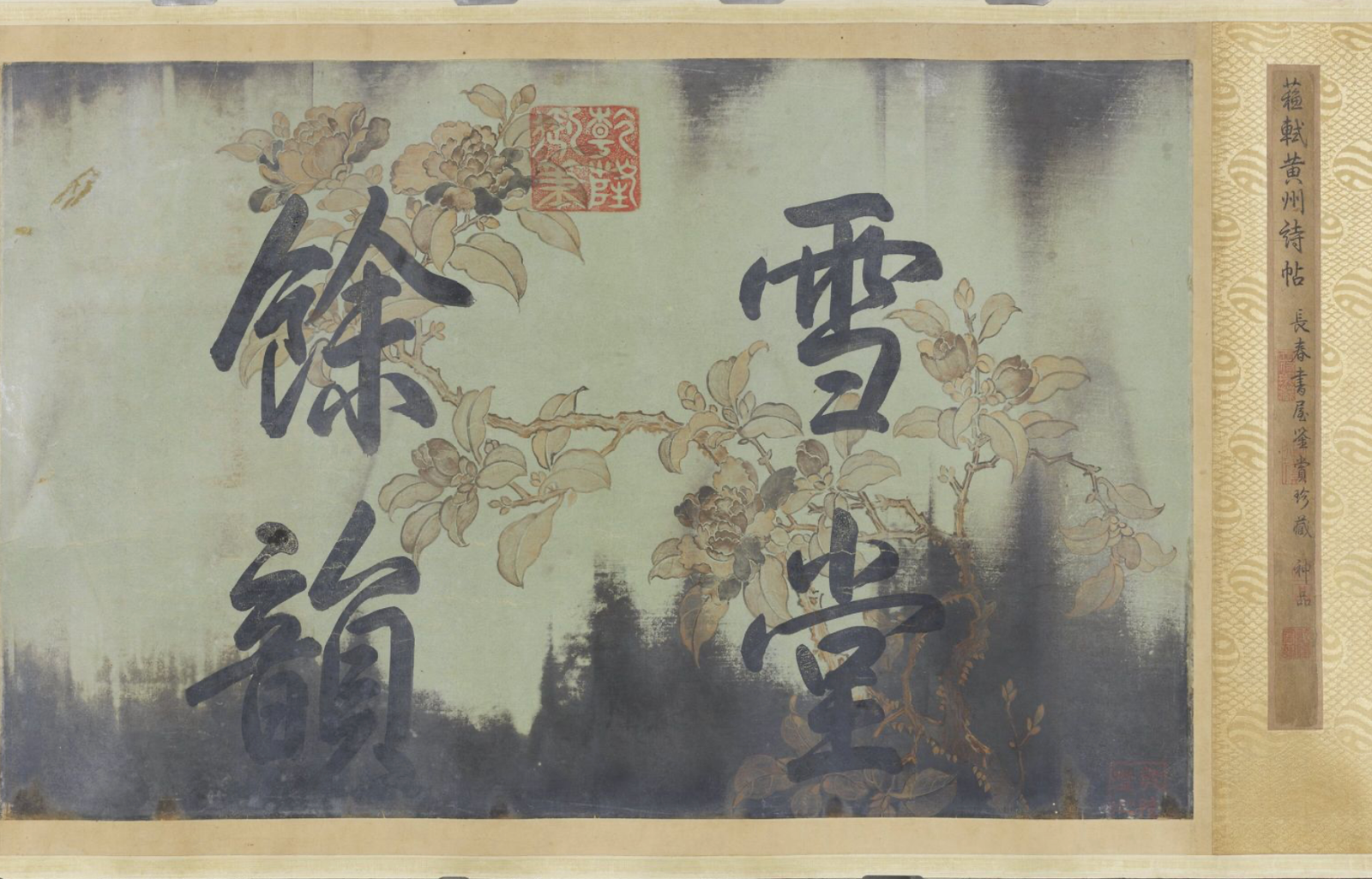
(Image- an example of Su Shi’s writing)
In the Yuan dynasty, the calligrapher Zhao Mengfu (趙孟頫, 1254–1322), commenting on Su Shi’s work, referred approvingly to this quality, describing it as externally soft yet internally firm, and saying that it was truly what one calls “iron wrapped in cotton”.
The image is striking: the brushstrokes can appear full, fluid, rounded and soft, yet beneath that softness there is structure, stability and force. The line does not need to look hard in order to possess strength.
The image later found its way into martial arts discourse. In Taijiquan, for example, the expression came to describe the body of a highly accomplished practitioner: apparently soft and yielding yet possessing an unexpected heaviness and internal strength.
The historical journey of the expression is interesting, but what interests me more is the principle contained within the image.
Softness and strength
There is an old idea running through much of the philosophical and martial culture of East Asia that genuine strength does not necessarily present itself as hardness.
Laozi writes in the Dao De Jing:
天下之至柔,馳騁天下之至堅。
“The softest thing in the world penetrates the hardest thing in the world.”
And elsewhere:
柔弱勝剛強。
“The soft and weak overcome the hard and strong.”
Zhuangzi develops similar images, including the apparently insubstantial wind that is nevertheless capable of uprooting trees and overturning buildings.
Sunzi approaches the same principle from a strategic perspective. In The Art of War, one finds the instruction that when capable, one should appear incapable; when strong, one should not necessarily display that strength. Water, too, becomes one of his great images: it takes the shape of the terrain rather than imposing a fixed form upon it.
This way of thinking eventually becomes deeply embedded in Japanese martial culture as well.
Musashi’s Book of Five Rings uses water as the central image of the Water Scroll, emphasising adaptability and freedom from fixed form. Takuan Sōhō, writing about the relationship between Zen and swordsmanship, repeatedly warns against allowing the mind to become fettered in one place. Yagyū Munenori likewise develops the idea that the mind must remain free rather than becoming rigidly attached to a particular technique, position or object.
These are not necessarily different versions of exactly the same teaching, and it would be a mistake to flatten them into one universal doctrine. But they share a striking sensibility: softness and adaptability do not necessarily indicate weakness.
The body
In our modern era, permeated as we are by the psychologisation of the individual, ideas such as these can very quickly be understood intellectually as merely “states of mind” – something to be hacked, cultivated or accessed through the right mental attitude.
But for the people who wrote about these things, and especially for warriors, the matter was much more concrete. Knowing when to yield had practical consequences. The ability to remain relaxed under pressure had practical consequences. The ability to act without unnecessary tension had practical consequences.
These were embodied qualities.
This is why I do not think it is possible to make a meaningful separation between “mind” and “body” in this context. There is a definite quality of being that we are looking to manifest through our bodies, and it can be felt in someone who possesses it. This is why I prefer to speak of mind-body rather than treating the two as separate things. Whatever physical tension we carry is intimately connected to the way we are experiencing and responding to what is happening.
It is to be treated as a skill to be developed, one that has the ability to remain as free of unnecessary tension as possible while retaining postural and tactical integrity, applying the appropriate amount of strength required for a particular technique or sequence of movements.
Suppleness, mobility, sensitivity and the ability to act according to principles rather than reacting through resistance. The ability to remain structurally and tactically sound without unnecessary tension. When done properly, these qualities can be extremely powerful while appearing almost effortless.
In terms of obvious physical cues, our deshi should be developing sensitivity and awareness of their own physical tension so that they can release it. Relaxed shoulders and chest, an ability to ground the energy provided by uke, and a body that remains available to movement are all part of this.
Of course, strength is necessary. This is also why, in our dojo, we encourage our students to practise some form of strength training, including kettlebells or barbells. But strength training, like everything else, needs to be cultivated intelligently.
If it is poorly structured or performed without attention to mobility and quality of movement, it can reinforce exactly the opposite of what we are trying to develop. A person can become stronger, but also increasingly rigid, with musculature that is less mobile and a body that carries more unnecessary tension.
Likewise, flexibility without structure can become fragility. We do not want cotton without iron. And we do not want iron without cotton. We want iron wrapped in cotton.
Uke
This is also where the role of uke in Aikido becomes particularly important.
The role of uke provides an opportunity for a particular kind of cultivation because it requires vulnerability. We must allow our balance to be disturbed. We must allow our body to be moved. We must learn to fall. We must repeatedly experience situations in which we are not completely in control.
At first, we may think that this is simply something we have to endure while we are beginners.
Recently, one of our new students joked with me that she was “good at getting beaten up.”
We laughed, of course.
From the perspective of someone who has just started Aikido, there can indeed seem to be a lot of being thrown around, pinned, immobilised and generally made very aware of how little control we actually have over our bodies.
But I told her that this part of the training is fundamental.
We often imagine that we only “get beaten up” at the beginning, until eventually we become good enough not to be thrown around anymore (for the record, my sensei still beats me up). But perhaps that misses the point.
There is enormous value in repeatedly placing ourselves in a position of vulnerability. As uke, we are constantly being asked to let go of fixed positions- physically and mentally.
We learn to stop fighting every movement. We learn to stop protecting every position. We learn to stop identifying so strongly with the need to remain in control.
And perhaps, over time, these physical and mental fixations begin to give way to something else: an embodied quality of strength and resilience.
This is where the image of 綿裹鐵 becomes meaningful again.
The aim is not to become harder simply because we have learned how to withstand being thrown around. Nor is it to become so relaxed that we lose our structure.
Through repeatedly experiencing vulnerability, we cultivate a body that can remain mobile under pressure, a mind that can remain open when its expectations are challenged, and a kind of resilience that does not need to present itself as hardness.
We become stronger by learning that we do not always have to resist. We become more resilient by becoming willing to be vulnerable.
And ideally, the strength that develops through this process does not make us harder toward the world. It allows us to become softer without becoming weaker.
Uke and nage
But there is an important distinction here.
We are not only uke. We are uke-nage.
The qualities cultivated while receiving a technique must also be manifested when we return to the role of nage.
It is not particularly useful to become a skilful uke, capable of releasing resistance, abandoning unnecessary tension and letting go of our ego, only to return to the role of nage and immediately begin forcing, controlling and imposing the technique.
If we learn not to resist unnecessarily as uke, we must also learn not to impose unnecessarily as nage. If we learn to let go of control, we need to carry that quality into the moment when we are responsible for the technique.
If we learn to become vulnerable, we must learn to act without being afraid of that vulnerability. Otherwise, we create an artificial division within our own training.
One part of the practice begins to cultivate something while another part immediately destroys it.
When uke and nage become opponents
There is another aspect of the uke-nage relationship that I think is worth considering.
In some dojos where the combative aspect of martial arts is heavily emphasised, there can be a fundamental misunderstanding of what the roles of uke and nage are actually for.
The forms of Aikido are sometimes treated as if they were ready-made self-defence techniques: someone attacks, I perform the technique, and the technique works.
But kata do not work like that. They are not “plug and play” solutions to violence.
A simple experiment is enough to reveal the problem. Ask a friend who has no knowledge of the exercise to attack you in an entirely unpredictable way and then try to reproduce your Aikido technique exactly as you have practised it. Very quickly, the assumptions built into the form begin to fall apart.
This does not mean that Aikido has no relationship to martial effectiveness or self-protection. It means that the training form and the situation of actual violence are not the same thing.
The purpose of uke is therefore not simply to play the role of “the attacker” so that nage can practise defeating them. Nor is the purpose of nage to prove that they can overcome uke. They are partners in a method of cultivation.
The attack supplied by uke creates a particular set of conditions within which nage can learn to perceive, organise, move and act. In turn, nage’s movement gives uke something to respond to, receive and learn from.
The relationship is therefore cooperative without being merely compliant. There is real pressure. There is real vulnerability. There is real possibility of error. But the purpose is not to establish a winner.
If we turn the exercise into a contest of wills, we may make it more visibly “martial”, but we can also lose precisely what the form was designed to teach. The paradox is that uke and nage need each other precisely because neither is supposed to exist independently.
Uke gives nage something to work with. Nage gives uke something to receive. And both are being transformed by the interaction. This is perhaps another reason why the quality of softness matters so much.
If uke attacks with the intention of defeating nage, and nage responds with the intention of overpowering uke, the training can very easily become an exchange of competing egos.
But if both practitioners understand the role they are playing within the larger process, the same physical interaction becomes something very different. The attack becomes an opportunity. The technique becomes an investigation. And the vulnerability becomes part of the method.
A lesson in the dojo
I remember an experience I had in Japan that brought this to my attention.
The training in that particular dojo was remarkably soft. The practitioners moved with lightness, fluidity and ease. There was very little visible tension. The training was dynamic, but also gentle in its quality.
Then, at the end of the class, they reached an exercise such as kokyūhō. Suddenly, the quality changed. People began forcing and contesting in the exercise, resisting one another and fighting who could impose their will.
It struck me as strange that after spending an entire class cultivating one quality, the final exercise seemed to encourage its opposite.
Of course, this is not only a question of the students. It is also the responsibility of the teacher. The role of the teacher is not simply to show students how to perform a technique. The teacher must also remind their deshi how to be while performing it.
Suffice it to say, the quality needs to carry through the entire practice.
A horizon
And this is ultimately why this calligraphy now hangs in our kamiza.
We do not expect this quality to manifest tomorrow. Or the day after tomorrow. It is an extremely high aim.
It is something in which the physical, mental and spiritual dimensions of practice gradually mature together, perhaps over decades, provided that we maintain awareness of what we are actually cultivating.
It is entirely possible to practise for decades without becoming particularly conscious of this dimension of training. Years of practice do not automatically produce incorporation.
One can become attached to a teacher, a style, an institution, a rank or a particular way of doing things without ever really asking what qualities are being embodied through the practice.
That is why the calligraphy is not there to tell us that we have arrived. It is there as a reminder. No one becomes “iron wrapped in cotton” tomorrow.
Perhaps no one ever fully arrives there.
But the image remains before us every time we bow in, every time we train, every time we struggle against our own habits and limitations.
Like Kenshō, it is simply another finger pointing toward the moon.
A reminder that the path of Aikido is not merely about becoming stronger, nor merely about becoming softer, but about discovering how genuine strength and genuine softness might cease to be opposites altogether.
Kenshō reminds us to look within, to investigate our own nature through practice.
Mián guǒ tiě (綿裹鐵) reminds us that whatever we discover there must eventually become embodied.
The insight cannot remain merely intellectual. The practice has to become something we can feel in the way we stand, move, receive, act and relate to others. We look within. We cultivate the body. We learn to yield. We learn to act from that place.
And slowly, perhaps, strength no longer needs to look like hardness. Perhaps it can finally become what the image on our kamiza suggests: iron, wrapped in cotton.