
BUDO IN THE AGE OF TOURISM: The Tourist and the Pilgrim in Aikido Training
Written by Ivan Melo
Recently, I was watching a conversation between philosophers on YouTube. The discussion revolved around the loss of the sacred in everyday life in the twenty-first century. The moderator was John Vervaeke, whose many projects and initiatives are devoted to helping people recover meaning in their lives through philosophical practices and ways of living. Toward the end of the conversation, they turned to a comparison between tourism – a phenomenon made possible only in the modern era – and pilgrimage.
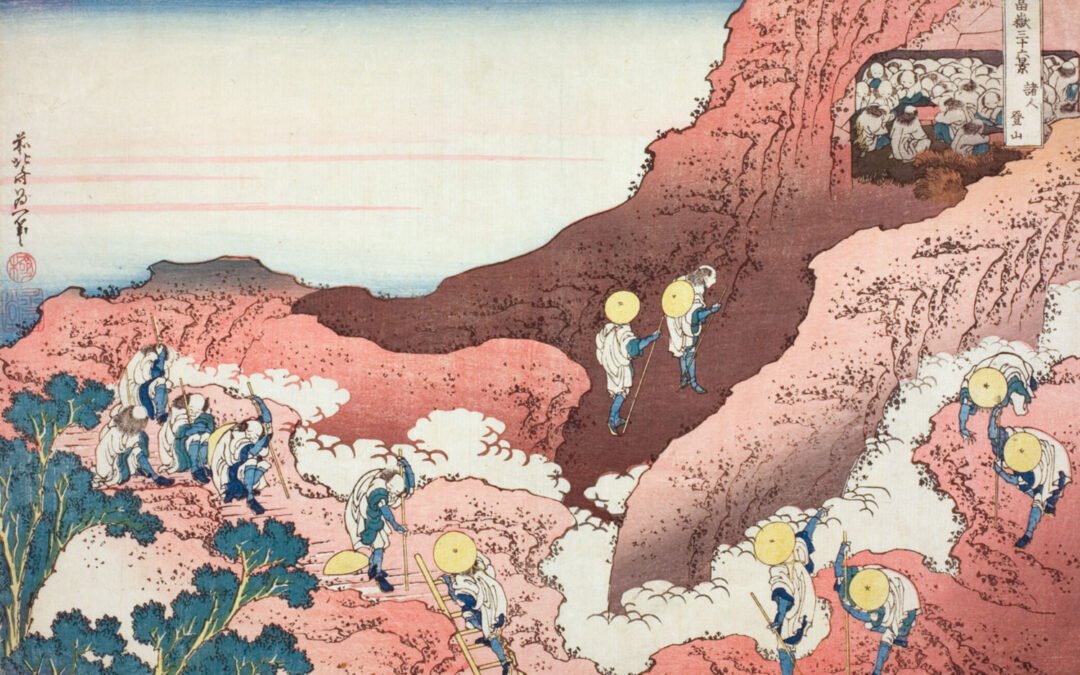
According to Vervaeke, to make a pilgrimage is to leave one’s place of origin in search of, or at least in the hope of, transformation. Pilgrimage is a profoundly human activity, found across cultures and stretching far back into our distant past. Some even argue that the Greek word theoria (“contemplation”) originated in the practice of pilgrimage, where the long stretches of travel between sacred sites offered ample time for reflection.
Pilgrimage has almost always had religious motivations: an attempt to reconnect the human spirit with something greater than itself. There have also been pilgrimages undertaken in search of healing, through visits to sacred places containing the relics of saints, shrines devoted to spirits, and countless other holy sites. In the pre-modern world, pilgrimage was an undertaking of extraordinary difficulty, often involving months or even years of travel from one sacred place to another.
During the same conversation, the philosopher Mastropietro describes the tourist as someone who is “impermeable” to the world around them. The tourist travels in enclosed buses, follows predetermined itineraries, and wants certainty about what they will see and experience. Time for contemplation and reflection is often non-existent, as they rush from one destination to the next.
I remember spending an afternoon at Daitoku-ji in Kyoto, the birthplace of countless Buddhist masters, quietly absorbing the atmosphere, when suddenly several tour groups entered in a tremendous commotion. They hurried through the temple gardens, taking photographs with every imaginable electronic device, never pausing for even a second to truly look at the famous Zen gardens before disappearing five minutes later, having “consumed” the scenery.
In short, the tourist seeks comfort, pleasure, and convenience, carrying their own world with them wherever they go. The pilgrim, by contrast, leaves their world behind in the hope of being transformed by the journey itself.
Many Aikidoka, thoroughly immersed in the conveniences of modern life, approach their relationship with Aikido in much the same way.
Consider the modern Aikido seminar. Although it has never been an ideal educational model, it originally served an important purpose: transmitting the basic forms of the art at a time when qualified instructors were scarce. Over time, however, it also became an effective means of raising money for organizers and federations, and it largely continues to serve that function today.
Today, seminars are convenient. Rather than seeking out a teacher, the teacher comes to you – the exact opposite of the movement that once characterized the search for mastery.
In Japan, alongside explicitly religious pilgrimages such as the Kumano Kodō or the Shikoku pilgrimage, there also existed musha shugyō: the warrior’s pilgrimage. Warriors travelled across the country seeking encounters and duels with renowned martial artists in order to learn, challenge themselves, test their understanding, and transform their martial ability. It was a pursuit that was both potentially – and often literally – fatal.
Nowadays, I’ve noticed that many people do not even attend an entire seminar or train with people outside of their usual group. They set aside only a few hours of their weekend to satisfy their curiosity or to “consume” the latest celebrity on the tatami. In the overwhelming majority of cases, gatherings of this kind possess very little transformative potential. After all, with four hundred people on the mat in some of the largest cities in the world, meaningful instruction and practice become virtually impossible.
I remember when the Dōshu visited Brazil more than twenty years ago. He was scheduled to teach from a stage, with giant screens projecting his movements so that an audience of over a thousand practitioners could see him- all in exchange for an exorbitant fee.
Just like the tourists at the temple in Kyoto, the Aikido tourist attends a seminar to take a photograph, turning the teacher-celebrity into an object and ultimately into a souvenir.
But reification always has two sides. There are not only those who consume the celebrity; there are also those who willingly allow themselves to be consumed.
Some instructors have realised that, in the attention economy of social media, becoming a spectacle brings far greater recognition than becoming a master. Within this context, carefully choreographed performances, acrobatic demonstrations, and visually impressive techniques cease to be merely pedagogical tools and instead become products.
The teacher ceases to be a guide and becomes an object of consumption, while the student ceases to be a disciple and becomes a spectator. The master’s worth is increasingly measured in views, followers, photographs, and their ability to entertain. The practitioner, in turn, no longer seeks the transformation embodied by the teacher; instead, they seek only the experience of having been near them, much like someone visiting a famous monument.
The logic of tourism remains intact: experiences are collected, yet none of them profoundly transforms the person who has them.
It is striking that a practice which claims to seek the emptying of the ego so often ends up reproducing precisely the opposite logic. The teacher becomes a brand; the student turns that brand into part of their own identity. Photographs, certificates, and seminars become forms of symbolic capital.
Instead of disappearing, the ego simply changes clothes.
Shirakawa is perhaps the clearest example of this phenomenon. His presence on social media appears to embrace, quite consciously, the role of the celebrity on the tatami, reinforcing a culture in which the image of the practitioner matters more than their transformation.
This is not, however, a personal criticism of him. If Shirakawa were to disappear tomorrow, someone else would immediately take his place. Celebrity culture does not originate with the individual; it produces the individual. The problem is not the person, but the structure that turns teachers into products and practitioners into consumers.
The seminar model is remarkably easy to sustain. It is convenient, entertaining, possesses very little transformative potential, and lacks clearly defined educational objectives. In other words, it embodies almost the exact opposite of what we would normally expect from any genuine spiritual practice.
I say this because the Dōshu himself – the leader of the Way – once described Aikido as a spiritual practice. If we accept his statement, then we are compelled to ask a simple question:
What spiritual transformation is Aikido actually meant to produce?
Every spiritual tradition has a telos. Whether it is drawing closer to God, to Allah, attaining enlightenment, realising satori, becoming more Christ-like, or becoming more like the Buddha, spiritual practice always points toward some form of transformation.
Aikido, however, has no clearly articulated goal. As a result, it can become almost anything: a lifestyle, exercise, cosplay, personal wellness…
The same ambiguity exists technically. Not long ago I watched someone who had spent years training in Japan explain that Aikido is “just like Brazilian Jiu-Jitsu – but different… the same, only with a different emphasis.”
There is also another kind of tourist: the one who includes visits to local dojos as part of their itinerary.
Recently, at my own teacher’s dojo, we received one such visitor. Failing to observe even the most basic courtesies both on and off the tatami, and showing no openness toward what was being taught, he remained entirely “impermeable” to the local culture.
Let me be clear: I have nothing against tourism, comfort, or the pursuit of pleasure. What concerns me is approaching tourism as an escape from everyday life, an escape from oneself, and an indiscriminate pursuit of hedonism.
I do believe that the journey itself – and the places we encounter along the way – can profoundly affect the pilgrim’s inner life.
I will never forget the week Cathy and I spent walking alone through the mountains of Wakayama along the Kumano Kodō. Nor the extraordinary atmosphere in the central square of Santiago de Compostela after visiting the shrine of Saint James. Nor the experience of practising zazen in the zendō of Kōshō-ji, the temple founded by Dōgen Zenji.
The same is true of those weeks spent in intensive Aikido retreats, whether in Spain or in the English countryside.
Yet I see the external environment only as an inspiration for a search that is, fundamentally, an inward one. Pilgrimage takes place in your own dojo. It may happen while reading a book, during a profound conversation with another seeker, or in silent contemplation.
The pilgrim responds to the deepest call within themselves by looking outward with permeability, allowing transformation to take place. Perhaps this is precisely why so many people today feel that the sacred has disappeared. Not because it has vanished from the world, but because we have learned to move through the world as tourists.
The sacred does not reveal itself to the gaze that merely consumes. It reveals itself to the gaze that is willing to be transformed.