
Written by Ivan Melo
In the society we live in today, writing occupies a central place in the transmission of ideas. Books, articles, manuals, and documents are important ways of preserving and transmitting knowledge. But no one truly learns simply by possessing a book. To learn, one must open the book, read it, study it, dissect its paragraphs, ask questions, take notes, compare ideas from different authors, doubt, confirm, and apply what has been read.
Each person will have their own method. Some will study systematically, others more intuitively. But in any case, the process is clear: whoever wishes to learn must enter the text.
The Neo-Confucian thinker Lu Jiuyuan is attributed with the phrase:
“I annotate the Six Classics; The Six Classics annotate me.”
It is a beautiful image: we do not merely read the text; the text also reads us, reorganises us, and transforms us. Written knowledge, when truly studied, ceases to be mere information and begins to become embodied.
When this knowledge is technical, it must be brought into practice until it becomes skill. Musicians understand this well: the black marks on the page are not the music itself, but a map for performance and interpretation.
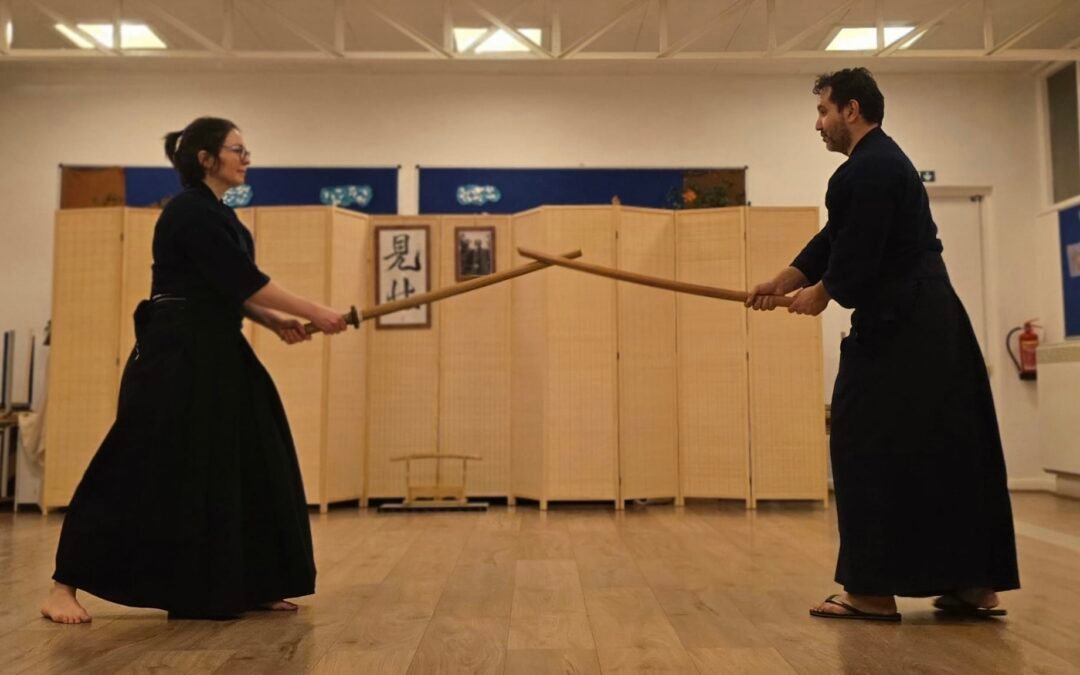
Before depending on writing, reading, or a widely literate culture, many forms of knowledge had to be preserved in the body. Kata fulfils this function. Kata is a vessel, a physical book, ensuring that tactical and technical architectures are transmitted across generations.
In this sense, kata can be understood as a pre-modern form of knowledge transmission: a way of preserving and communicating principles of combat without depending exclusively on written text. Even when certificates were given from teacher to student, they often contained very little actual technical instruction. The verbal transmission, kuden, was responsible for passing on the hidden details contained within the kata. After all, no writing system is complete enough to describe the multidimensional complexity of a human body in motion.
Training in Japan reflects this idea of memory. The word keiko, often used to refer to the period of practice or training, means something like “to revisit the past” or “to reflect upon what is ancient”. And this is what we see as one of the most widespread practices in dojos around the world. Training has largely become a revisiting of the past, so that at some future moment we may retrieve this information from memory in the hope of defending oneself against an attacker or, mostly likely, achieving a perfect score on the next grading or competition – something that perhaps also reflects the current model of education and the logic of our academic society.
It is not by chance that one of the most common observations – and complaints – from teachers when teaching Aikido seminars is precisely that many students are not truly seeing what is being shown. They are simply acting from muscle memory.
However, maintaining kata only as memory is like owning a book without ever having opened it. And if someone asks: “What is the content of this book?” “What is it for?” “What kind of knowledge does it transmit?”; we are left without an answer.
Systems of bodily transmission should not be frozen like museum pieces, preserved with reverence but without investigation. If we do this, we risk transforming practice into empty curation: we preserve an ancient book, feel pride in protecting it, but cannot explain what it contains.
Preserving a form without understanding its function is also a subtle form of arrogance. It is as if the age of an object alone were enough to justify its importance, and as if the curator became a great intellectual simply by holding the keys to the vault.
But discarding through ignorance is also problematic. Countless generations have tested and refined every vessel of transmission that has reached us. We are not the ones – human beings of the twenty-first century, distracted by screens and stepping onto the tatami once a week – who can casually decide what should be preserved and what should be abandoned.
That said, one must doubt kata – not out of disrespect, but out of seriousness. We must ask why a posture exists, why a certain angle was chosen, why a hand is placed there, why the body moves in that way, what kind of pressure is being studied, and what kind of response is being organised.
And all of this cannot remain merely in the intellectual realm of the “keyboard warriors” of the internet. It must be placed into practice.
To doubt does not mean to reject. It means to investigate. It means to test, confirm, and place the practice in relationship with the living body of another practitioner. It means asking what happens when there is resistance, distance, intention, fear, error, speed, pressure, and unpredictability.
In martial arts, tradition does not live merely because it is old. It lives when it is practised, studied, questioned, and embodied.
To learn the technical body of a combat system is precisely to open these bodily books. It is to study their information, criticise it, apply it, and allow it to become experience again.
Kata should not be an untouchable relic. It may be considered beautiful, ancient, and worthy of respect, but a book that is never opened remains closed: full of possibilities, but not necessarily alive. Kata must be transcended. It is not the final destination, but a doorway.
And a doorway only fulfils its function when it passed through.